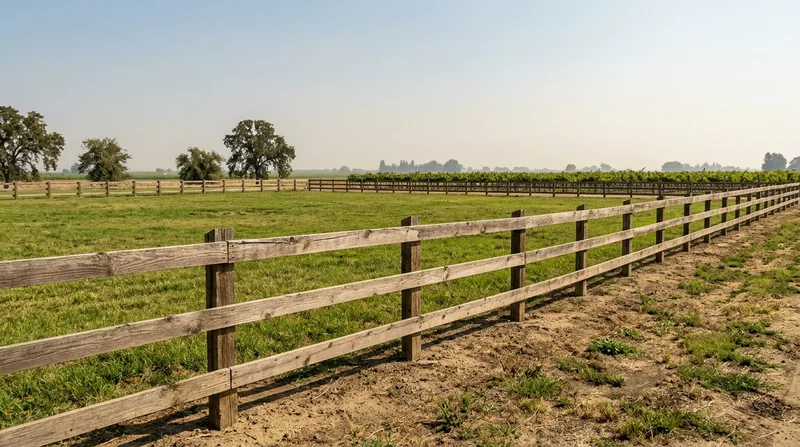




Getting farm fence installation in Stockton right starts with the ground, not the materials. The flat clay and hardpan east of the San Joaquin River swells in winter and shrinks hard by August, and that movement is what racks gates and pulls corners out of line on acreage from Lodi to Escalon. We build ranch rail, no-climb horse fence, field wire and pipe fence for orchards, vineyards, walnut ground and ranchettes across San Joaquin County, with straight lines over long runs and gates sized for a stock trailer. The same crews set the posts, brace the corners and hang the gates. If you are fencing a yard rather than a field, start with our wood and privacy fence installation page instead.
Why Farm and Ranch Fencing Matters on Stockton Acreage
The land around Stockton is flat and open, which sounds easy until you run a fence line a quarter mile and find three soft spots where a winter slough left silt over hardpan. Posts in that ground need deeper holes and more concrete, or they lean by the second wet season. Wind off the Delta and atmospheric-river storms push on long unsupported runs, and a field wire fence with weak corners will sag before the wire itself ever fails.
- Expansive clay moves posts, so we set corners and gate posts deeper and in concrete rather than tamped.
- Long runs need bracing every few hundred feet, not just at the ends, or the line bows under wind load.
- Orchard and vineyard rows demand straight sight lines, which means stringing the line before a single hole is dug.
- Livestock fencing has to match the animal: no-climb mesh for horses, field wire and barbed wire for cattle and open ground.
Every one of those points gets settled on site before we quote a linear foot number.
Key info: On a ranchette off Liberty Road near Linden, a homeowner's old field fence had posts leaning 10 degrees after two wet winters. We reset the corners in concrete, added a brace panel on each side of the gate, and the line has held straight since. The wire was fine. The corners were not.
Fence rules on unincorporated acreage differ from city rules, so check with the San Joaquin County building department before you build. You can find their permit contacts through the San Joaquin County government site.
How We Build a Ranch Fence Line Across San Joaquin County
We walk the line with you first, because gate placement and trailer turning radius decide more of the layout than most people expect. Then we call 811 for utility locates before any digging, string the line, and set posts at consistent spacing so the rails and mesh run true. Corners get braced, gates get hung to swing clear of the ground, and we stretch wire with a stretcher bar rather than by hand.
- We walk the property and mark gate locations for trailers, equipment and livestock movement.
- We call 811 for utility locates and confirm the fence line you want installed.
- We string the line and set posts in concrete at the spacing the material requires.
- We brace corners and gate posts, then stretch and fasten rails, mesh or wire.
- We hang gates, check swing and latch, and walk the finished line with you.
If the job includes a driveway entrance, we coordinate it with our automatic and driveway gate installation work so the operator and the fence line are planned together.
Key info: A vineyard parcel outside Escalon needed 900 feet of no-climb horse fence plus a 12-foot gate for a flatbed. We set the gate posts 4 feet deep in concrete because the soil there is clay over hardpan, and the gate still swings level today.
Farm and Ranch Fence Methods We Install
The right fence depends on what you are keeping in, what you are keeping out, and how much wind the line takes. These are the four we build most around Stockton and the surrounding farmland.
| Approach | Description | Best for |
|---|---|---|
| Split rail | Wood or vinyl rails on posts set in concrete, 2 or 3 rails, with or without wire mesh behind. | Ranchettes, property edges and decorative entry runs. |
| No-climb horse fence | Woven wire mesh with small openings, tightly stretched, top rail optional. | Horse paddocks and turnout where hooves are a concern. |
| Pipe fence | Steel pipe posts and rails, welded or sleeved, set in concrete. | Working pens, heavy livestock and high-traffic gate areas. |
| Barbed wire and field wire | T-posts or wood posts with stretched wire strands and a top wire. | Open pasture, orchard perimeters and large acreage. |
Farm and Ranch Fencing Cost in Stockton: What to Expect
Plan on a starting point of from $12 per linear foot for basic farm fencing, and expect the number to move with the material, the ground and the gate count. Split rail and field wire sit at the low end. No-climb horse fence and pipe run higher because of material cost and heavier setting. Long runs are cheaper per foot than short ones, since mobilization is spread over more line.
What moves the price most: soil conditions and how deep posts must go, the number and size of gates, clearing brush or old fence off the line, and distance from the road or the nearest water source for mixing concrete. Getting two or three estimates is smart on any acreage job, because the proposals should differ in post depth and bracing, not just in the bottom line. Our full fence pricing overview breaks down the ranges by material.
Hiring a Farm Fence Contractor Near Me in Stockton
Ask for a certificate of insurance showing general liability and workers' compensation before work starts, and confirm who is actually on the crew. Get at least two written estimates and call references from jobs of similar size.
On acreage, also ask whether the contractor calls 811 before digging and how they handle gates and corners in clay. If your land sits under an HOA or deed restriction, verify height and material rules before ordering anything. Reach out through our contact and free estimate page to set up a site walk.
Farm and Ranch Fencing Near Me: What Stockton Homeowners Should Know
Most calls we get from Stockton, Lodi, Manteca and Tracy are for a ranchette or a few acres at the edge of town, not a full commercial ranch. That means a mix of split rail at the front, no-climb around a paddock, and a pipe gate at the driveway. We quote those the same way we quote a long orchard run: walk the line, check the ground, and price the corners and gates properly.
If you are comparing options, our chain link installation page covers the lighter-duty alternative for property edges and storage areas. For anything with livestock, stick with woven wire or pipe. Call (209) 546-6481 and we will tell you straight which fence fits the ground you have.
Farm & Ranch Fencing in Stockton: Pricing Guide
| Service | Price | Details |
|---|---|---|
| Field wire and T-post fence | Starting at $12/ft | Basic pasture perimeter with wood corners and stretched wire; price rises with gate count and brush clearing. |
| Split rail fence | Starting at $18/ft | Wood or vinyl rails on concrete-set posts; cost moves with rail count and whether wire mesh is added. |
| No-climb horse fence | Starting at $22/ft | Woven mesh tightly stretched on braced posts; heavier setting in clay and top rail add to the rate. |
| Pipe fence and working pens | On estimate | Welded or sleeved steel layout depends on pen design, gate sizes and site access, so it needs an on-site look. |
| Travel | Included | in Stockton and surrounding San Joaquin County farmland, no separate call-out or mileage fee. |
| Estimate | Free | Site walk and written quote within 24 hours at (209) 546-6481, no obligation to book. |
Indicative pricing, the exact cost depends on square footage, finish, and site access. Free personalized estimate within 24h at (209) 546-6481.


